
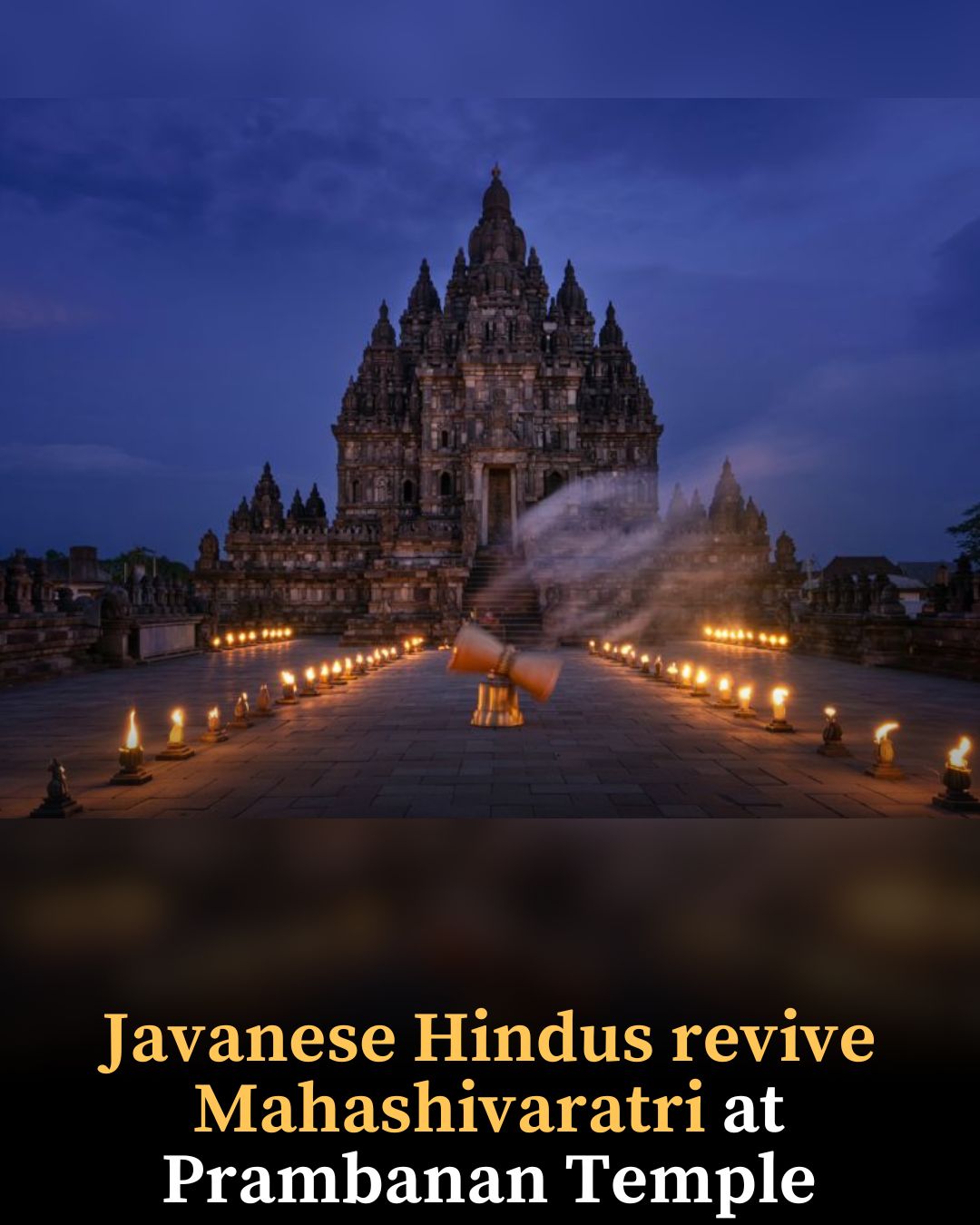
Mahashivaratri (15th February 2026), marked the month-long Prambanan Shiva Festival at the UNESCO heritage site in Yogyakarta, Java (Indonesia). The Prambanan complex is the second largest Hindu temple in South East Asia. Consisting of 240 free-standing temples, the complex is dominated by a central temple of Shiva, with temples of Vishnu and Brahma on either side. Hindu and Buddhist Dharmas arrived peacefully in Indonesia in the early first millennium due to the movement of traders from India. The temples at Prambanan were built in the 9th century CE under the Mataram Hindu-Buddhist kingdom that flourished in Java between the 8th–11th centuries. After the Islamisation of Indonesia, Hindu influence declined across Java and most of Indonesia with the exception of Bali which till today remains Hindu majority. On Java, though official records suggest Hindus accounting for less than 1% of the population, in many regions the local population is Muslim in name only as they continue to practice Hindu and older animist traditions. Following a period of political turmoil in the 1960s, areas of Java, particularly East and Central, witnessed several communities formally reverting to Hindu Dharma.
One of the patterns of the Hindu revival in Java is the revival of ancient temples. Prambanan was abandoned in the 10th century and subsequently suffered damage due to earthquakes. The 1930s saw the start of restoration of the complex – an ongoing effort that continues. In the 1990s Hindus from Java and Bali resumed rituals at the site and in 2019, this archaeological site was formally revived as a place of active worship with a grand Abhisheka purification ceremony. The Shiva festival at Prambanan not only reflects the increasing Hindu consciousness of the Javanese but also the Indonesian Government’s desire to increase tourism at the site. The Mahashivaratri event saw the temple illuminated with 1008 sacred lamps, the playing of Shiva’s sacred damaru and the performance of Shiva Puja throughout the night.