
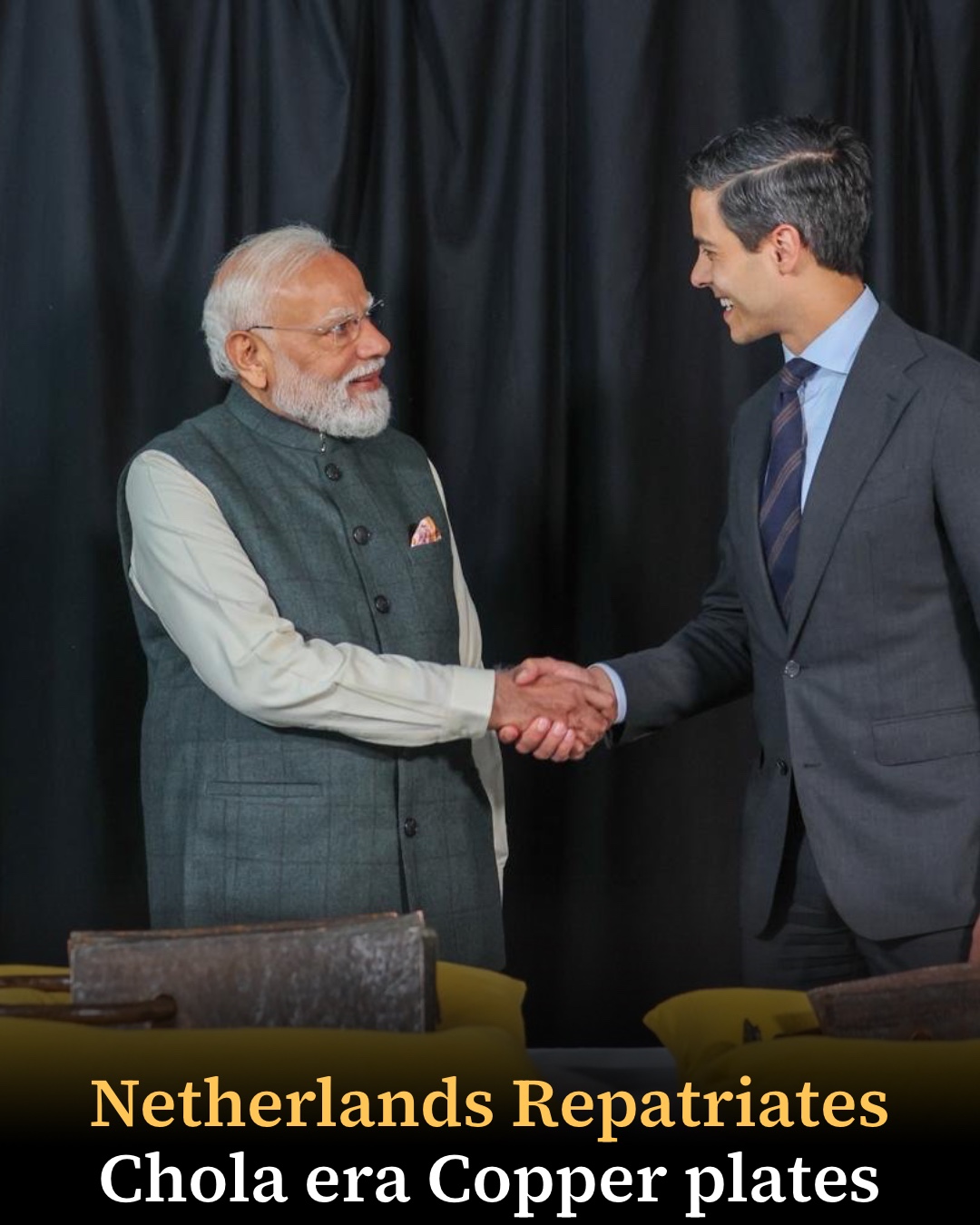
16th May 2026: The Dutch Government repatriated the 11th-century Anaimangalam Copper plates (also known as the Leiden Plates) alongside a Chola-era bronze sculpture to India during Narendra Modi’s visit to the Netherlands. The plates were taken by Dutch officials from the SE coast of India in the 18th Century when the region was under Dutch East India Company control and have been preserved at Leiden University since 1862. The artefacts consist of 21 large and three small copper sheets bearing inscriptions in both Sanskrit and Tamil, to record a grant made by the Rajaraja Chola I (who reigned between 985 to 1014 CE) to a Buddhist monastery located in the ancient port town of Nagappattinam (Tamil Nadu, India). The monastery was built by the Sailendra rulers of the Srivijaya Empire that dominated Southeast Asia. The copper plates are bound by a bronze seal, bearing the insignia of Rajaraja’s son Rajendra Chola I who recorded the grant.
These plates are significant artefacts in the study of the Chola Empire. Originating from banks of the Kaveri river in Tamil Nadu, the Cholas created one of the greatest Naval empires in the world and ruled over much of Southern India between 9th and 13th centuries CE. Under Rajaraja I and his son Rajendra I, the empire reached its peak, with territory expanding into Eastern India, Sri Lanka and control of sea trade routes in Southeast Asia. The Cholasthe region witnessed a flourishing of military strategy, international trade, art, architecture and Hindu Dharma. Rajaraja I built the Brihadesvara Siva Temple in Thanjavur; one of India’s grandest temples in India. Though largely Saiva, the Cholas expanded and built temples of both Shiva and Vishnu across Tamil Nadu. This grant towards the Buddhist monastery, reflects the cosmopolitan ethos of the era, where Hindu kings also patronised the institutions of the non-Vedic Dharmas.