
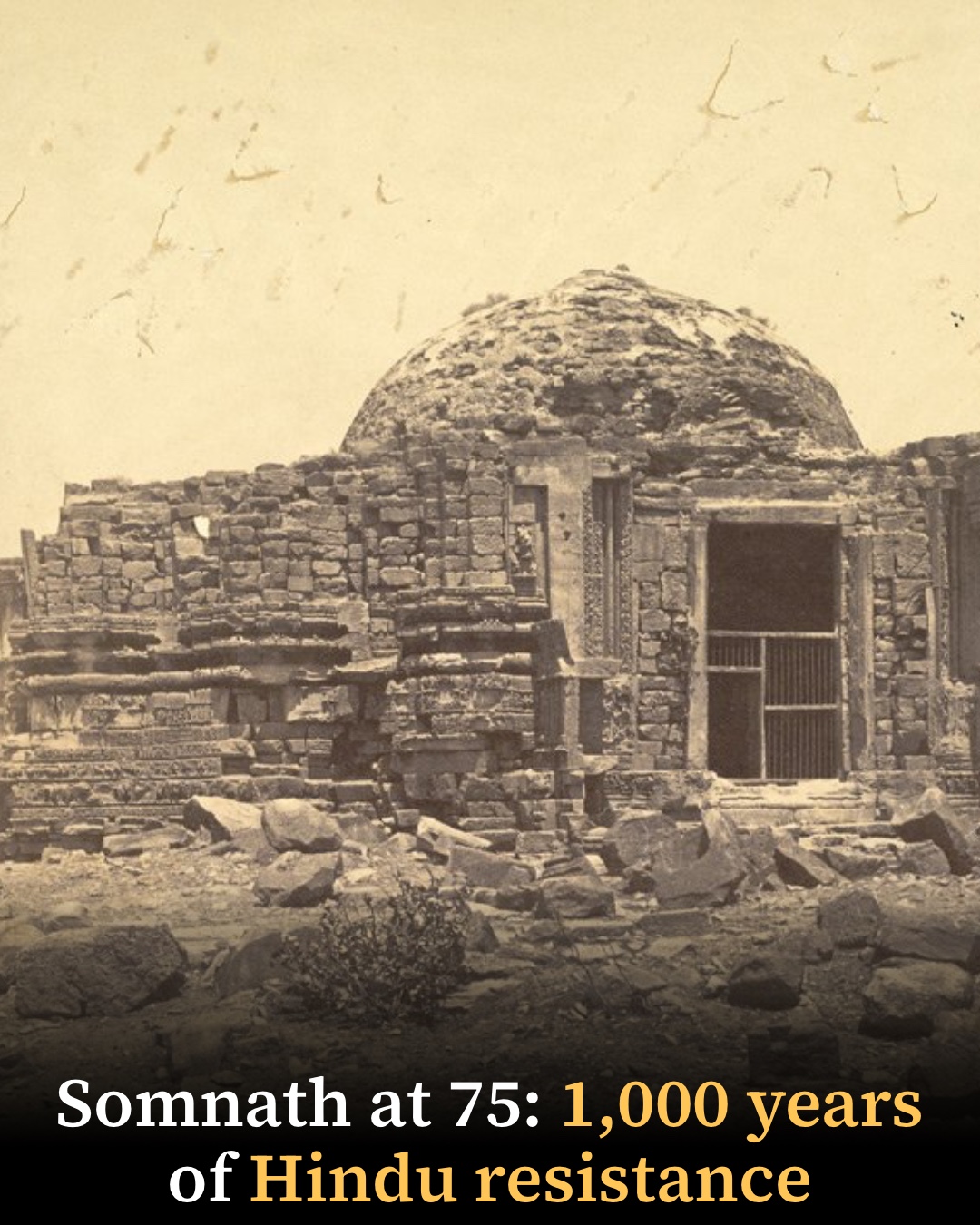
The 11th century witnessed the devastating invasions of Mahmud of Ghazni (now Afghanistan) into Bharat, when temples were targeted and Hindus were taken as slaves. In January 1026, Ghazni attacked Somnath, severely damaging the temple and looting its wealth. The Shivalingam was destroyed and its pieces sent back to pave the steps of Ghazni’s mosque. This was more than an act of plunder; it was a deliberate attempt to exert the supremacy of Islam and humiliate Hindus. 1026 marks the start of a history of repeated attempts by Islamists to attack Somnath but also a history of Hindus resisting. During Ghazni’s attack, over 50,000 brave Hindus sacrificed their lives defending the temple—a determination and resilience that would be repeatedly shown for the next 1000 years. Five years after Ghazni’s attack, King Bhima I of Gujarat repaired the temple. Gujarat recovered from the devastation of Ghazni’s invasion, growing more prosperous than before. In 1169, the temple was expanded and exquisitely restored by King Kumarpal. After Delhi fell to Islamic rule, the army of Alauddin Khalji plundered and destroyed the temple in 1299. King Mahipal of the Chudasama dynasty rebuilt the temple in the early 1300s. By the late 14th century, Gujarat came under Islamic occupation. In 1451, Mahmud Begada, the Sultan of Gujarat, attacked and converted Somnath into a mosque, but by the 1500s Hindus resumed worship. In 1665 and 1706, the Mughal emperor Aurangzeb ordered Somnath’s demolition, but this was not followed through.
The 18th-century Queen, Ahilyabai Holkar, revived temples ravaged by Islamists—Somnath was one of her projects. Due to extensive damage to the original temple and fearing further attacks, in 1783 Ahilyabai constructed a smaller temple 200 metres away and installed the deity in an underground shrine. In the 19th century, during the British colonial period, the area came under the control of the Muslim ruler of Junagadh who resisted attempts by Hindus to restore the site. Hindus, however, remained firm in their resolve, and in the early years of India’s independence the temple was finally revived.
About the image: A photograph taken in 1869 showing the ruins of the old Somnath temple with modifications to create a mosque.