
The story of Somnath enters the 20th century with writings and campaign of Indian independence activist and politician, K. M. Munshi, who in 1922 visited Prabhas and envisioned the revival of the temple. In August 1947 when India gained her freedom, the fate of Somnath was perilous due to its location in the princely state of Junagadh. Though surrounded by Indian territory and home to a 80% Hindu population, the state’s Muslim ruler; the Nawab of Junagadh, wished to merge with Pakistan. Due to public pressure, Indian military intervention and a referendum, the Nawab did not succeed and in October 1947 Junagadh merged with India. A few weeks later, India’s new home minister, Sardar Patel, visited the ruins of Somnath temple where on the day of Gujarati new year, he along with Munshi made the resolve to rebuild the temple.
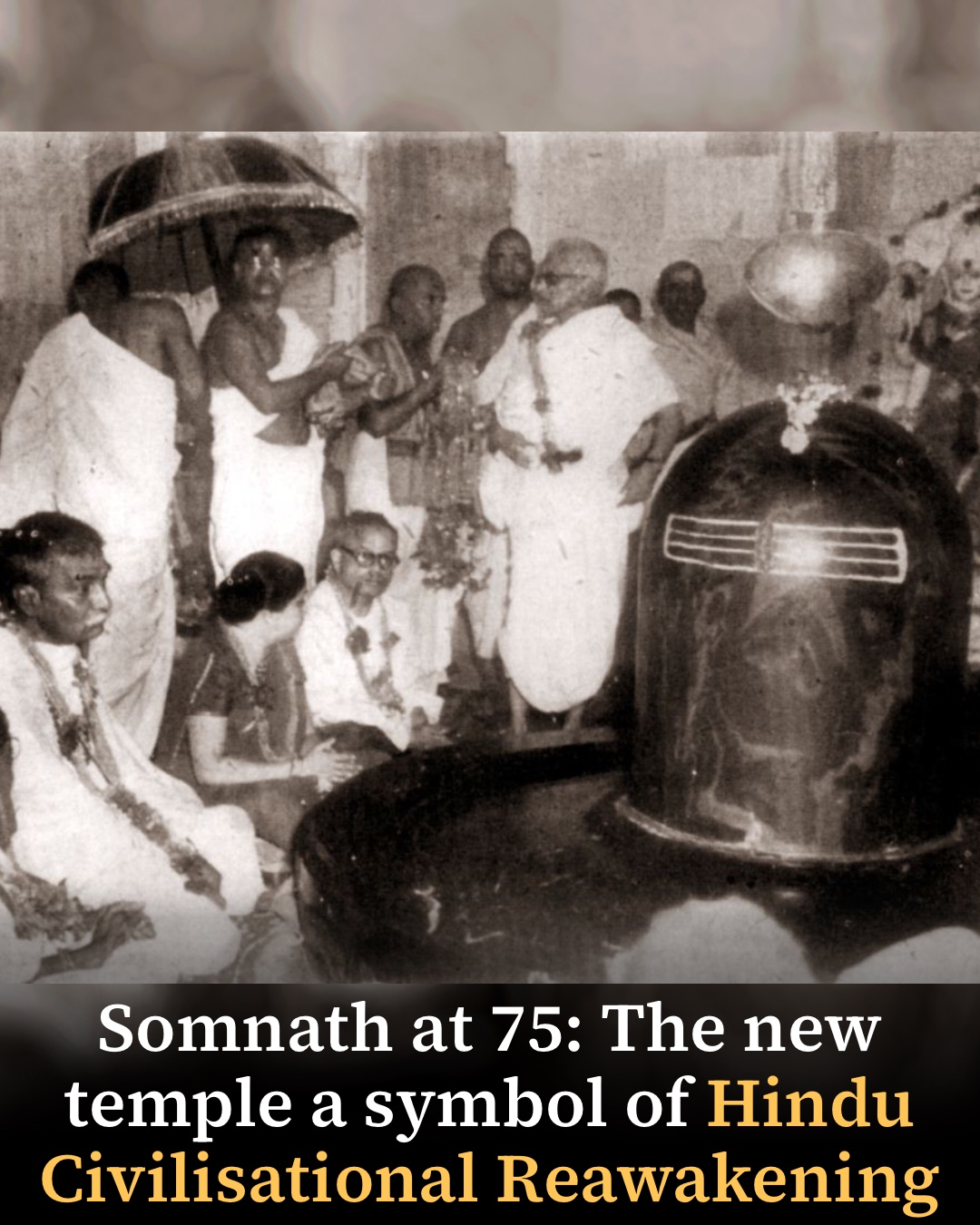
Mohandas Gandhi (despite not holding elected position) urged Patel that the temple could be built without public funds. Hindus from across the country therefore came together to raise 2,492,000 rupees for the restoration of Somnath. In addition to the temple of Shiva, the nearby Dehotsarg (the site where Krishna left his body) was revived, as well as creation of a Sanskrit University. In May 1950, the foundations of the new temple were laid and on the 13th May 1965 the new Shivalinga was installed in the newly built sanctum (see image). The revival of Somnath was a powerful statement of India’s indigenous Hindu culture asserting its confidence after centuries of colonial rule. Much like the struggle of previous centuries, the efforts by Hindus to reclaim the site in the newly independent India were met with resistance. In contrast to Sardar Patel, India’s first Prime Minister Jawaharlal Nehru opposed the rebuilding of Somnath. In a series of letters to between 1950 and 1951, Nehru expresses his unease of a Hindu revival and tries to obstruct the revival of the temple, included a failed attempt to stop India president Dr Rajendra Prasad from participating in the Pratishta of the Shivalinga.