
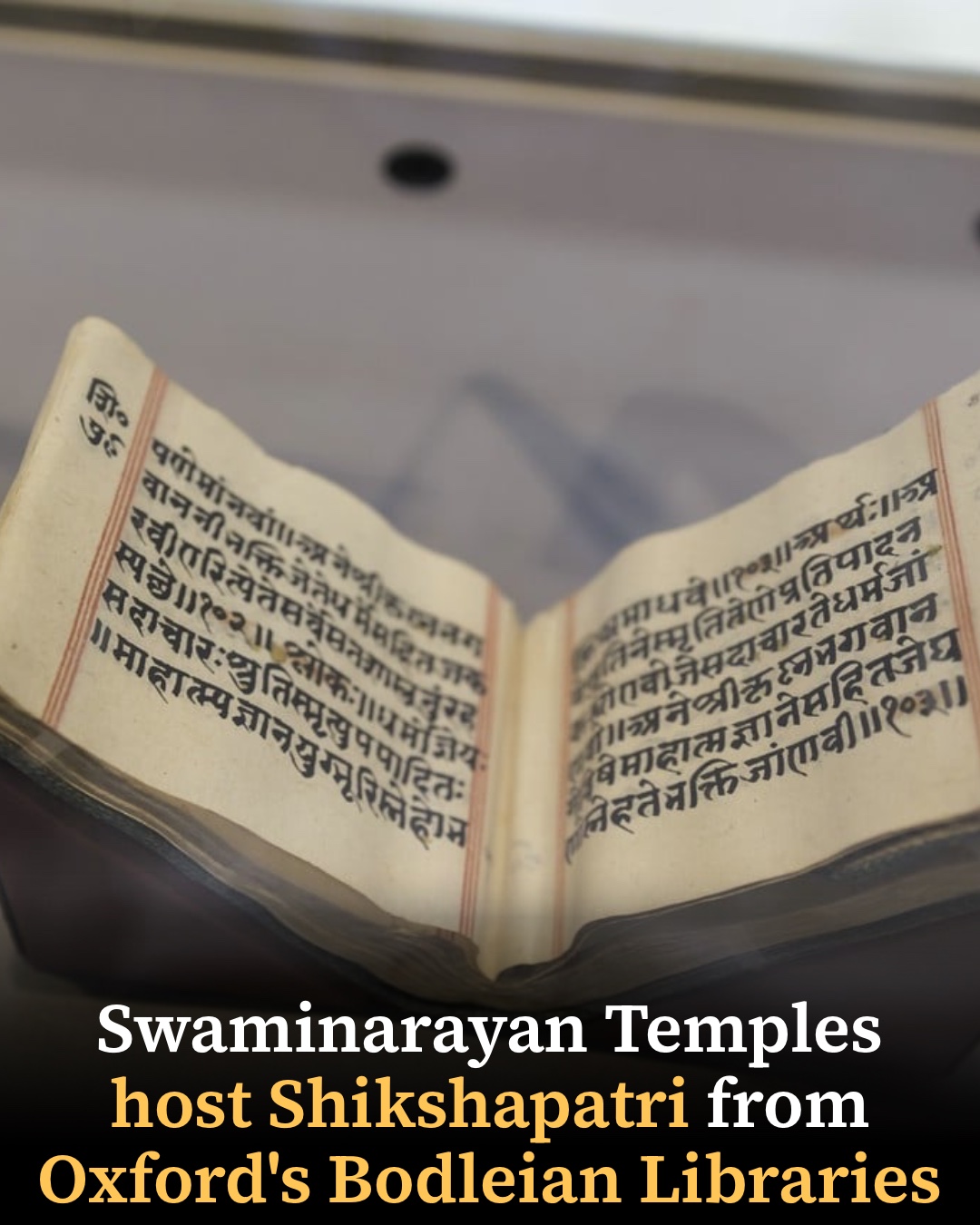
One of the oldest known copies of the Shikshapatri is going on tour of several Swaminarayan Temples across the UK this summer, marking 200 years since the composition of the text. This handwritten manuscript is usually preserved at the University of Oxford’s Bodleian Libraries @bodleianlibraries. Consisting of 212 verses, the Shikshapatri outlines the code of conduct for the Swaminarayan Sampradaya. It was written by Swaminarayan hence it is one of the most important texts in the tradition. This copy was gifted by Swaminarayan to Sir John Malcom, the Governor of Bombay, in 1830.
In addition to instructions on behaviour and conduct of followers, in the Shikshapatri, Swaminarayan details the spiritual practices of his tradition that centre on Bhakti (devotion) to the personal form of Brahman (Saguna Upasana), specifically in the form of Krishna. Verses outline different forms of Krishna that should be installed in temples (i.e. Radhakrishna, Nara-Narayan, Lakshmi-Narayan etc.), and instructions are given to revere Krishna-centric scriptures, festivals and places of pilgrimage. Though drawing upon Vaishnava traditions, the Shikshapatri asserts Shiva a form of the Supreme on par with Krishna and instructs on the worship of the Panchadevas (Ganesh, Surya, Devi, Shiva, Vishnu). Swaminarayan did not compose his own commentary of Vedanta and in verse 100 of Shikshapatri, he accepts the established Visishitadvaita (qualified non-dualism) of Ramanuja as his preferred school of Philosophy.
The text provides instructions for both householder (grihasta) and renouncer (sadhu) followers. Swaminarayan also instructed the duties of his successors, who he names as two of his nephews and their direct descendants. These Acharyas (spiritual leaders) were specifically selected as being householders, they would initiate and instruct male followers with their wives (Gadiwala) assuming the same role for females. Since January 2026, the text has been loaned out for viewing at Swaminarayan temples in Cardiff, and across London in Kenton, Willesden, Stanmore, Woolwich, Harrow and Forest Gate. Kingsbury in London will host later this summer.